Now, with the dawn of the new millennium and the complete cleaning of the cathedral's surface, its rejuvenated appearance more clearly reveals its magnificence and the diverse architectural influences of a building whose construction began in the early 14th century upon the ruins of two pre-Romanesque and Romanesque basilicas . Thanks to the relics it houses, Oviedo Cathedral welcomed pilgrims throughout the Middle Ages and became an essential stop on the Camino de Santiago.
Why does the Cathedral of Oviedo only have one tower?
The cathedral took a staggering three centuries to build , and it was constructed according to the principles of Flamboyant Gothic , the dominant style of the time. But the prevailing canons of the era don't seem to have influenced the architects, who, faced with unforeseen construction problems, opted for a more conventional approach. This is why we see only one tower , and not two as is typical in the rest of European Gothic architecture.
It's a nearly 80-meter-tall tower that had to be built despite financial constraints, numerous technical problems, and even seismic activity. But be that as it may, there it stands, majestic and freshly cleaned, revealing a pointed treasure with countless sculpted edges, its crown dating back to 1587, and considered the last of the Gothic architectural works.
The tower, visible from almost any point in Oviedo, holds a dominant position in the city's perspective, despite a considerable allusion to the same figure on the first page of the memorable novel La Regenta: "The eye did not tire of contemplating for hours and hours that stone index that pointed to the sky; it was not one of those towers whose spire breaks from subtlety, more thin than slender, affected like affected young ladies who tighten their corsets too much; it was solid without losing any of its spiritual grandeur, and up to its second corridors, an elegant balustrade, it rose like a strong castle, launching itself from there in a pyramid of graceful angle, inimitable in its measurements and proportions."

Let's go inside. The interior of the Cathedral of El Salvador , as it is called, winds through the nooks and crannies of a Latin cross floor plan with three naves, chapels between buttresses, and a polygonal apse behind which lie seven spaces dedicated to the worship of various apostles. These latter spaces contain memorable Baroque altarpieces of Italian influence. The main altarpiece is the most remarkable, for along with those of Toledo and Seville, it embodies the most valuable triad of Spanish cathedral apses , with a vast iconography and a high theological density of its message.
Inside the temple we continue to see one of the most meritorious aspects of Oviedo Cathedral for the history of Spanish Gothic: the fact that in it we find architectural elements representative of all phases of Gothic architecture, from the classicism of the late 13th century to the late Hispano-Flemish stage of the 16th century , passing through the intermediate ones of the 14th century (Mannerist) or the 15th century (Flamenco).
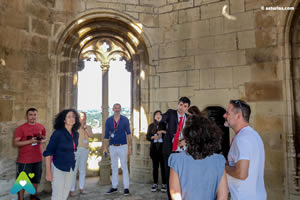
Visit to the tower of the Cathedral
The tower of Oviedo Cathedral is one of the best viewpoints in the city, and thanks to a visit… Read more
What relics are in the Holy Chamber of the Cathedral of Oviedo?
The cathedral is rich in hidden corners, such as the 16th-century Chapel of King Casto in the left transept, or other rooms built in the purist Gothic style of the late 13th century, as is the case with the Chapter House and some of the cloister galleries. But it is essential to mention one corner that stands out above the rest: the Holy Chamber , an architectural remnant of the original structure that stood on this site, which is both a treasure trove of Romanesque sculpture and the sacred relics of the Asturian kingdom.
The Cathedral of El Salvador stands on the same site as an earlier pre-Romanesque cathedral from the 9th century (during the reign of Alfonso II), which in some ways influenced the structure of the Gothic building. Thus, the Holy Chamber contains either the first or last vestige of the original temple, depending on one's perspective.
The Holy Chamber is a two-story space . The lower level is the original pre-Romanesque, while the upper level is Romanesque, dating from the 12th century . It is a vaulted space in which the twelve Apostles were sculpted, paired two by two, on the columns that support the arches.
This same upper floor houses the Cathedral Treasury , the result of successive donations of relics and luxury items that the Asturian monarchs began to contribute as early as the 9th century. Among this unique treasure, a symbol of the Principality, the most prominent are the Cross of the Angels , the Cross of Victory (featured on the regional flag), the Mozarabic-style Agate Reliquary , and the Holy Shroud . Today, grilles and alarms protect this unparalleled treasure after a heinous robbery in 1977 shocked the Asturian people. The pieces were recovered, although some suffered considerable damage after the theft and had to be reconstructed.
When can you see the Holy Shroud of Oviedo?
There is only three dates indicated in the calendar: Good Friday, September 14, Holy Cross Day and September 21, Saint Matthew's Day -Local festivity.
The Holy Shroud is the garment that covered the face of the Lord when lowering him from the cross and therefore is impregnated with his blood. It is the most important relic of Christianity along with the Shroud of Turin, which was the canvas with which the Lord was wrapped in the tomb.
Adjacent to the Holy Chamber is the Cloister , an even more striking example of the passage of time and the successive architectural styles employed in the cathedral. Its iconography encompasses both secular and religious themes. It also includes Asturian motifs such as Favila's fight with the bear.
Oviedo Cathedral: opening hours
MASSES
· Chapter Mass from Monday to Saturday 09:15 am in the Chapel of Santa Barbara.
· Mass at 12:00 noon from Monday to Saturday in the Chapel of the King Casto.
SUNDAYS AND HOLIDAYS OF PRECEPT
· Saturday and eve of party at 18:30.
· Sundays and holidays at 10:00, 11:00, 12:00, 13:00 and 18:30.
CONFESSIONS
· Monday to Saturday 9:15 a.m. to 10:15 a.m. (Penitentiary).
· Saturday afternoon from 16:30 to 18:15 (Penitentiary).
· Sundays and holidays from 10:00 to 11:00 (Penitentiary).
· Other Confessors from 11:00 to 13:30 and from 18:30 to 19:00.
· Cathedral Office: Monday to Saturday from 10:30 a.m. to 12:30 p.m.
Source: Cathedral of El Salvador Oviedo.
Text: © Ramón Molleda for asturias.com