WEBCAM
 webcamsdeasturias.com
For the people of Oviedo, Mount Naranco is like the Casa de Campo for the people of Madrid, Collserola for the people of Barcelona, or Mount Igueldo for the people of San Sebastián. It's a place deeply connected to the lives of the city's residents , who come to its slopes to enjoy the fresh air, appreciate its heritage, or participate in sports such as hiking or cycling.
The slopes of the Naranco are ideal for rewarding efforts: they are used for walking, training and competition. Throughout the year there are cycle tourism concentrations that aim to reach the top. The top of Naranco also welcomes those professional cyclists who are capable of taking down an entire squad to succeed alone. A short but very hard climb, which José Manuel Fuente made known for the first time in La Vuelta Ciclista in 1974.
· What to see in Mount Naranco?
The unparalleled scenery of this area is complemented by a wealth of attractions: a Finnish ski slope, hiking trails, riding clubs, recreational areas, cider houses, and monuments. The two jewels of pre-Romanesque art in Oviedo, Santa María del Naranco and San Miguel de Lillo, are located on the way to the summit, bestowing upon this mountain the indelible mark of the Asturian kingdom and its legendary status. Naranco holds a prominent place in the history of art thanks to these two monuments, declared World Heritage Sites by UNESCO . Few mountains boast such wonders. They are located 4 kilometers from the city center.

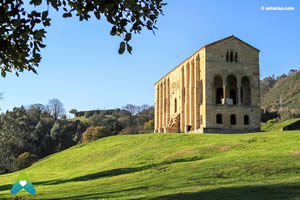
The Asturian pre-Romanesque of Oviedo
The most traditional architecture of Asturias dates back more than a thousand years. The traces of… Read more
From the very top, there is an extraordinary aerial view of the city of Oviedo and almost the entire municipality , as well as the towns of Llanera and Las Regueras. On a clear day, you can enjoy an exceptional and even more expansive panorama , reaching as far as much of central Asturias.
The magnificent Sacred Heart monument seems to invite one to delight in the vast landscape that blends, in an unusual way, the orderly urbanity with the rugged mountain nature. The Sierra del Aramo, in the foreground, crowns the highest peaks closest to the city.

The figure of Jesus, symbolically embracing and protecting the city of Oviedo, is often a sacred goal for many walkers who, from San Miguel de Lillo , ascending a steep but beautiful path, pass by the Fountain of the Shepherds, where they quench their thirst with the cleanest and freshest water in the city.
Climb Mount Naranco by car
Once the car is on the streets of Oviedo, we should look for the signs that point us towards Mount Naranco. The route follows Avenida de los Monumentos, which gradually climbs the mountainside , passing through a residential area – Ciudad Naranco – where modern and magnificent buildings abound.
As soon as the houses begin to thin out, Mount Naranco reveals its full beauty. Among the trees appears the large building of the Asturian Center and its adjacent facilities, set somewhat apart from the road. And then, without further delay, to the top, where the true viewpoint of the city is located. On the nearby Picu del Paisano, we see the imposing statue of the Sacred Heart.
Climb Mount Naranco on foot
From the center of Oviedo, you can walk to the Sacred Heart in just over an hour and a half. It's about 16 kilometers with a total elevation gain of 770 meters. You can start from Purificación Tomás Park in the Vallobín neighborhood. From the top of the park, a path leads off to the left, taking you comfortably to the town of Ules . Here, you begin a section along the road to the upper part of the area near Brañes. Turn right onto the paths that will quickly lead you to the summit of Llampaya , where you reach the top.
Text: © Ramón Molleda for asturias.com