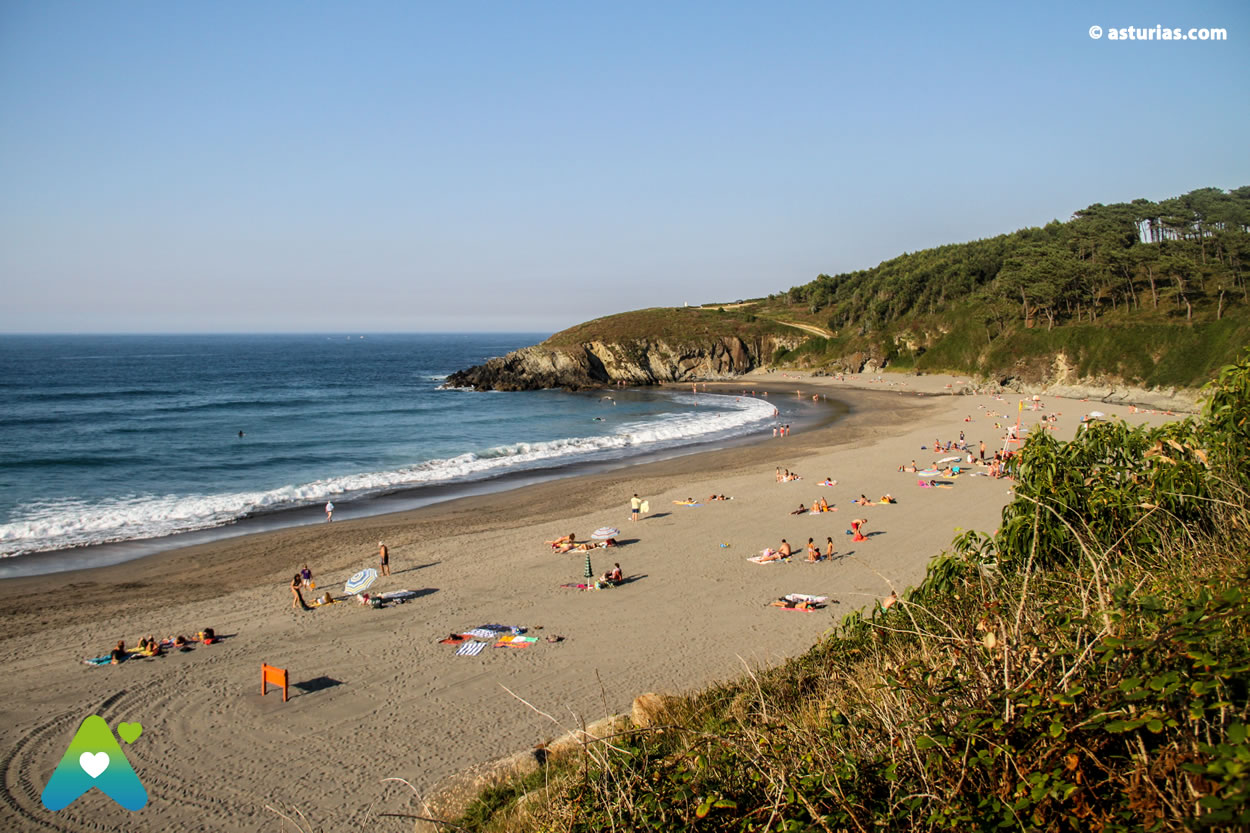
From Puerto de Vega and from the town of Frejulfe you have easy wheeled access. The beach is very welcoming, and its unusual toasted sand makes the room warmer and even more romantic. A sunset in Frejulfe, if the sea is calm, it is an ideal place to, for example, fall in love and take a photo of a couple against the light, as if we were in the Caribbean. The truth is that the sand, fine and with that brown sugar tone, rather seems to belong to the Mediterranean or Caribbean coast. And only the currents and the waves, more frequent than the stillness of the waters, when it collides impetuously against the rocks, reveals its Cantabrian condition. Waves that the surfers, habitual of this place, describe as powerful and hollow.
The beach environment is fascinating due to its vegetation. The sandy cove, about 700 meters long, houses an important dune vegetation and a thick pine forest in the rear.
The cliffs that surround it are part of the declaration of Natural Monument, next to the dunes, to the beach itself, and the idyllic estuary of the Frejulfe river that gives name to this piece of coast and flows into its bosom.
Although this is for note and for the biologists, it can be mentioned here that in the environment of the beach you can find lawns of «Scirpus parvulus», the only place in Asturias where they have managed to develop making this habitat more picturesque. Likewise, its fauna values with the presence of the otter, the green frog and the oystercatcher provide more wealth to its ecosystem and more rarity to the whole. They say for Navia that occasionally, carried away by the current, On the beach of Frejulfe beach marine animals. Since, clearly, its orientation is completely open to the sea, we are not surprised at anything that hosts the marine fauna.
By now you will have realized that the name of the beach is unpronounceable. Try to read it, repeat it two or three times watching it. Now close your eyes, wait a few seconds and try again Jefulgre, Fejulje, it is almost impossible, a mnemonic test of maximum difficulty.
The best thing is to go for a walk, because it is well known that language and memory live and feed on experience. Maybe after going through Frejulfe we will not find it so hard to pronounce it. Take the test.
Frejulfe beach: how to get there
The easiest access to the beach is made from the small village of Frexulfe from which a small road starts that, in just over 500 m, leads directly to the beach. To get to Frexulfe, just follow the National 634 to Navia and take the Local Highway NV-2 there. This location has special access for people with some kind of physical disability, as well as parking spaces for people with reduced mobility.
More attractive is the access from Soirana, from where a road that ends on top of a cliff starts, you can enjoy a natural viewpoint over the beach and it has a parking area. From here you access the beach by a comfortable pedestrian path equipped with railings.

Puerto de Vega, exemplary town
The inhabitants of Puerto de Vega move, they love their town. There are barely 2.000 residents but…
Coastal path of Navia
The Navia Coastal Path, despite being the oldest of all those that are part of the network of…
Text: © Ramón Molleda for asturias.com