In Asturias, there are 14 buildings in varying states of preservation , primarily located in the central part of the region. On Mount Naranco , at whose foot the city of Oviedo grows, stand two of the most representative monuments of Asturian pre-Romanesque art . These buildings clearly demonstrate the close relationship between architecture and sculpture. They are slender structures, yet of proportionate dimensions and without ostentation. Their utilitarian forms and austere ornamentation ultimately offer compelling stylistic arguments, an aesthetic unity of all elements that is all the more surprising given the early date of their emergence.
The city of Oviedo , as the former capital of the Kingdom of Asturias, holds remarkable architectural gems forged during 200 years of monarchy and Asturian pre-Romanesque art . This period spans from the beginning of Don Pelayo's reign in 722 until the death of Alfonso III in 910, when the royal capital was moved to León.
Santa María del Naranco
The popular palace of Santa María del Naranco was originally conceived as a royal residence, hunting lodge, and retreat for Ramiro I. Its beauty and functionality were admired even in the Middle Ages. It has two floors; the upper floor is a large vaulted hall that opens to the exterior through two spacious balconies. In the same century as its construction, the 9th century, it was converted into a church.
Of particular note are its Byzantine-style capitals , adorned with the typical Asturian ropework, and the depictions of animals and human figures. Near the monument is an Interpretation Center , whose explanatory panels illustrate the different stages of Asturian Pre-Romanesque art.

San Miguel de Lillo
A short distance away lies San Miguel de Lillo, also known as Liño . This royal church is believed to have been part of the monarch's nearby palace. The monument has survived to the present day in a much altered state. In the 13th century, it partially collapsed due to the poor condition of the ground on which it stands. Only the western section and the first bay of the nave remain of its original design. The decorative elements are particularly interesting; the reliefs on the door jambs are exquisitely crafted, as are the latticework and the interior gallery, designed to lend dignity to the religious ceremonies attended by the king.
If we're not in too much of a hurry, we can continue up to the top of the mountain. There we can enjoy truly breathtaking aerial views of the city of Oviedo.
San Julián de los Prados
Another beautiful example of Asturian pre-Romanesque architecture is located at the eastern entrance to the city. It is none other than the Church of San Julián de los Prados, or Santullano , as it is popularly known. King Alfonso II the Chaste dedicated this magnificent church to Saint Julian and his wife, Saint Basilissa. Dating from the 9th century, it was originally part of his palace outside the walls of Oviedo. It is the largest pre-Romanesque church still standing in Spain. It has three naves with a transept and three square-ended apses. Alongside its architecture, Santullano boasts a collection of paintings that makes it one of the most unique churches of early medieval Spanish art . It is known that frescoes covered the entire interior, including the ceiling, and have been linked to the mural paintings of the Pompeian tradition.
The fountain of Foncalada
A unique civil monument, built during the reign of Alfonso III the Great (866-910). It was declared a World Heritage Site by UNESCO in 1998. A must-see in the city of Oviedo.
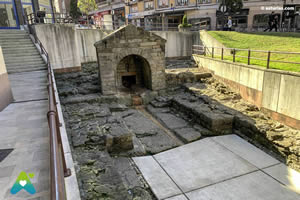
The fountain of Foncalada
It is located in an area… Read more
Text: © Ramón Molleda for asturias.com