The somedano Ecomuseum has two locations: Caunéu and Veigas. In the first of them, the exhibition focuses on two parts: the trades and the ethnographic routes.
It is located in the old Caunedo schools, built in 1953 and paid for by an emigrant to Cuba named José Feito Taladrid. Several of the most common trades in the area are represented: madreñeiro, carpinteiro, goxeiro, ferreiro and canteiro. The tools and processes of each of them are well represented.
We will also find a school classroom , with its wooden desks, its maps decorating the walls, and thus we go back in time half a century recreating a use typical of the building.
Somiedo has been linked to livestock since time immemorial , and its herds have always moved from the valley to the mountain passes. Three transhumance routes coexist throughout the year: an internal transhumance—from the villages to the nearby mountain pastures—the transhumance of the vaqueiros d'alzada—from villages in Somiedo to other villages at lower altitudes—and the so-called mesteña—from flocks of sheep from Extremadura to the mountain passes of Somiedo. All of this is reflected on the second floor of the exhibition building.
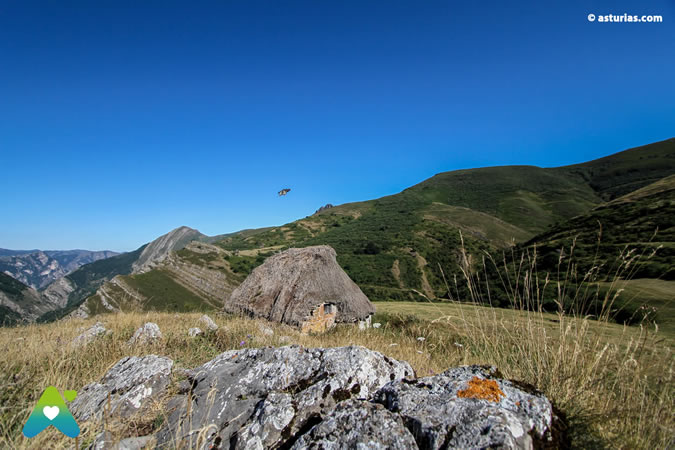
In the village of Veigas, a guided tour takes you inside three old houses that still have their traditional thatched roofs, the broom-thatched roofs so common in this area. These buildings were once used for livestock farming, clustered in mountain pastures scattered throughout the Somiedo region , and today there are several marked trails inviting visitors to explore them. There are thatched-roof cabins, like those in the Saliencia Valley, La Pornacal, and Braña Viecha, and others built entirely of stone using dry-stone techniques, such as those in Sousas and La Mesa.
When can we visit the Ecomuseum?
Trades and transhumance (Cauneu)
Winter (From September 16 to June 30)
Wednesday to Friday: from 11 a.m. to 14 p.m.
Saturday: from 11am to 14pm and from 16pm to 19pm.
Sunday: from 11am to 14pm and from 16pm to 18pm.
Monday and Tuesday closed.
Summer (From July 1 to September 15)
Monday to Sunday: from 11am to 14pm and from 16pm to 20pm.
· Houses (Vegas)
Winter (From September 16 to June 30)
Wednesday to Saturday: 11am to 14pm and 16pm to 19pm.
Sunday: 11am to 14pm and 16pm to 18pm.
Monday and Tuesday closed.
Summer (From July 1 to September 15)
Monday to Sunday: 11am to 14pm and 16pm to 20pm.
How much does it cost to enter the Ecomuseum?
Over 16 years: € 2 // Minors: € 1.
Groups of more than 15 people: € 1.
The same ticket is used to visit the two headquarters of the Ecomuseum (Caunéu and Veigas).
Exemptions: groups visiting school, holders of the youth card and children under 6 years of age.
For group visits it is necessary to arrange them in advance on the phone 985 76 39 84 or by email ecomuseodesomiedo@gmail.com
Source: Network of Ethnographic Museums of Asturias Red Meda.
Photos: Juan Pablo Torrente. Red Meda 2020.
Text: © Ramón Molleda for asturias.com