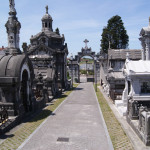


Always attentive walking through its wide streets and its most mournful corners, this fantastic Avilés cemetery encourages meditation and aesthetic delight at the same time. Its architecture, its sculptures and nineteenth-century ornaments are so beautiful that we can seriously think that the cemetery is a privilege for those who lie there, even if they are buried in perpetuity.
Its high heritage value makes La Carriona one of the most important cemeteries on the continent, forming part of the "European Route of Significant Cemeteries" ; an itinerary that increasingly attracts international tourists interested in this topic to Avilés.
A little bit of history
At the end of the 19th century , the Asturian city of Avilés was experiencing rapid economic growth and a population boom, and a new cemetery was in dire need of one as its existing ones were becoming too small. At that time, a Royal Decree of 1787 mandated that new cemeteries be built away from the city center, in "well-ventilated places and far from houses." The La Carriona area, a high point on the outskirts of the town, was an ideal location. Coincidentally, during this period many of the wealthy emigrants who had made their fortunes in the Americas returned to their hometown. These prominent figures dedicated part of their wealth to improving Avilés' infrastructure and, in turn, wished to leave their mark on the new cemetery. They built mausoleums decorated with exquisite carvings and sculptures that would accompany them into eternity.
Ricardo Marcos y Bausá , a collaborator on the "Linear City" project in Madrid, was commissioned to design the new necropolis. It was intended to accommodate all the deceased of Avilés, past and present, wealthy or poor. This City of the Dead, which extended the existing City of the Living, was planned with a large square layout and inaugurated in 1890. In its inclusive approach, it included from the outset an ossuary and a civil section for non-Catholics.
La Carriona: funerary museum
We are speaking, without a doubt, of the largest open-air museum in the city of Avilés. The beauty of some of the mausoleums and the cemetery as a whole has long garnered a steady stream of national and international accolades . Furthermore, it is a member of the ASCE (Association of Significant Cemeteries in Europe) and leads the EUCEMET project (European Cemeteries: Gardens of Souls, Diversity & Heritage), a community initiative to promote funerary art and its historic and monumental cemeteries.
La Carriona is a centuries-old cemetery that consistently appears on lists of the most beautiful cemeteries, primarily due to its monuments; those that the magazine "Adiós Cultural," specializing in funerary art, has repeatedly awarded. Such as the "Pantheon of the Marquises of San Juan de Nieva ," awarded Best Sculpture in Spanish Cemeteries in 2015. Or "The Slab of Time ," Best Monument in Spanish Cemeteries in 2022. A spectacular four-ton creation by the artist Carlos Suárez. It occupies the space of the former ossuary and its purpose is to recover the memory of the victims of the Franco regime. Undoubtedly, a unique and singular work that further enhances the significance of the necropolis.
Anyone needing another "gruesome" reason to visit La Carriona will find one: in 1993, in the area known as Los Franciscanos, an elderly man was found hanged from a cypress tree in the early afternoon. The 78-year-old, originally from Granada, had been visiting the cemetery for months to arrange his burial plot and ensure it was properly prepared. He even requested the exhumation of the remains already in his intended niche. This tragic event was nominated for a prestigious national award in the category of best documented story.
Illustrious Dead of Carriona
While the local bourgeoisie and the Indianos competed for the most ostentatious parcels and those closest to the chapel, hiring famous sculptors and architects to carry out their hypogea and allegorical carvings of a classicist style (trumpeter angels, cherubs, virgins...), other adjacent streets became They were filling with humbler and much more austere tombs, belonging to the working class.
La Carriona is ultimately an eclectic museum , where the most pretentious statues compete with owls, snakes, skulls… while crosses of all kinds are scattered throughout the crypts. It's easy to imagine that in the realm of the dead all the dead are equally "illustrious," and that it will always be a mistake for the living to value some more than others. But however unfair it may seem, and without wishing to offend anyone for the thousands of omissions we will inevitably make, these could be the most distinguished tombs in the City of the Dead (considering how "illustrious" their inhabitants were in life, thanks to their wealth or their abilities):
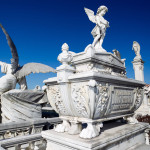
The most prominent burial site in the cemetery is the aforementioned "Pantheon of the Marquises of San Juan de Nieva ." Dating from 1902, it is crafted from Carrara marble. The most striking feature of the ensemble is a sculpture by the artist Cipriano Folgueras: an angel with outstretched wings holding a trumpet in its right hand while its left hand points towards the heavens. The family coat of arms and lion's claws, symbolizing strength and power, are visible on the tomb.
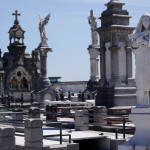
In the underground burial of the family of the Marquis of Teverga , a work by the same architect who designed the cemetery, Ricardo Marcos y Bausá, the Latin cross plan stands out, covered with a majestic barrel vault above which rises a large tower crowned by a winged angel.
The tomb of the writer Armando Palacio Valdés , built in 1941, features a sculpture of Demetria, a character from one of his most important works, "The Lost Village." Here we read a masterful epitaph: "Traveler, if one day you climb the mountains of Asturias and stumble upon the poet's tomb, leave a sprig of honeysuckle upon it. May God bless you and guide your steps with happiness through the Principality."
The tomb of the Asturian poet Ana de Valle , author of "Pájaro azul" (Blue Bird), who was exiled in France during the Franco regime, marks the end of her lifelong desire to return to her homeland. Floral offerings and collective readings of some of her poems are sometimes placed at her grave. Also buried in La Carriona Cemetery are Marcos del Torniello, one of the most important writers in the Asturian language; prominent politicians such as Julián García San Miguel and José Manuel Pedregal ; musicians like Julián Orbón , who adapted José Martí's poem "Guantanamera" into a popular song; athletes such as Yago Lamela , world runner-up in the long jump; and the legendary center forward for Sporting de Gijón, Enrique Castro "Quini," a much-loved figure whose grave is frequently visited.
La Carriona Interpretation Center
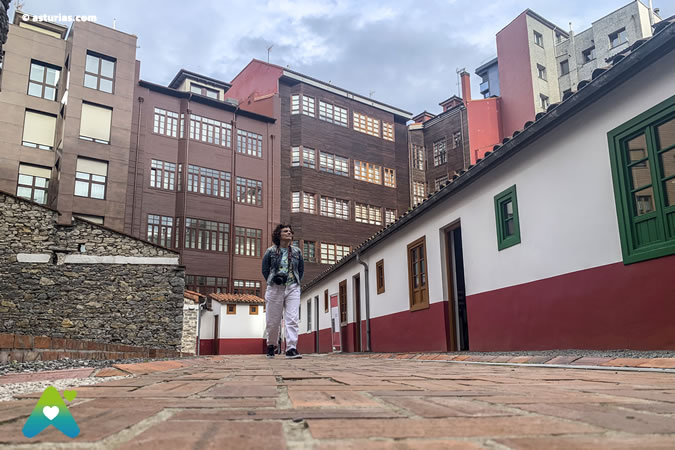
In 2012, coincidentally on the eve of All Saints' Day, the Avilés City Council launched a pioneering facility for the dissemination of funerary art and culture: The La Carriona Cemetery Interpretation Centre (CICLAC); located in the former residences of the caretaker and chaplain , here visitors have access to the technical plans of the most notable mausoleums, burial records and many other documents on the history of the cemetery; also educational audiovisuals and detailed information on the best works of La Carriona, its outstanding architects and sculptors and the most illustrious residents of Avilés buried here.
Various panels and brochures help visitors navigate the adjacent cemetery, highlighting its most significant features. Guided tours of the cemetery can also be arranged with prior registration. These tours offer detailed and engaging explanations of the two regularly scheduled routes: "Art Space" and "Place of Remembrance ." These two routes, which explore two distinct themes—sculptural and architectural works on the one hand, and the biographies of the deceased on the other—ultimately intertwine to provide a comprehensive view of past eras and our own present.
Guided tours La Carriona Cemetery
LOCATION
Calle La Carriona, 9
Public Transport: L-2 Central Station-La Carriona-Miranda
Coordinates: Latitude: 43.5421N – Longitude: – 5.9381W
Hours La Carriona Cemetery
From Monday to Friday working days: 10,00:13,00 a.m. to 16,00:18,00 p.m. and XNUMX:XNUMX p.m. to XNUMX:XNUMX p.m.
Saturdays, Sundays and holidays: 11,00:13,00 a.m. to XNUMX:XNUMX p.m.
PHONE : 985 541 939 – 985 565 512
EMAIL: museodeaviles@aviles.es
GUIDED TOURS: prior registration.
ENTRANCE AND GUIDED TOUR: free.
Photos «The Slab of Time» © Marcos Morilla/Avilés City Council.
Photos enclosure © La Carriona Cemetery.
Text: © Ramón Molleda for asturias.com